Content of this topic
Table views are used in many places in plusmeta. They can be found in many workflow steps, such as Add objects or Approve metadata, but also in main views, such as the projects view. The displayed elements in the table can be customized in various ways so that it is suitable for your individual use case.
General layout
Depending on which view the table view is in, there may be differences in the layout, especially in the columns. The main elements that appear in almost every table view are described below.
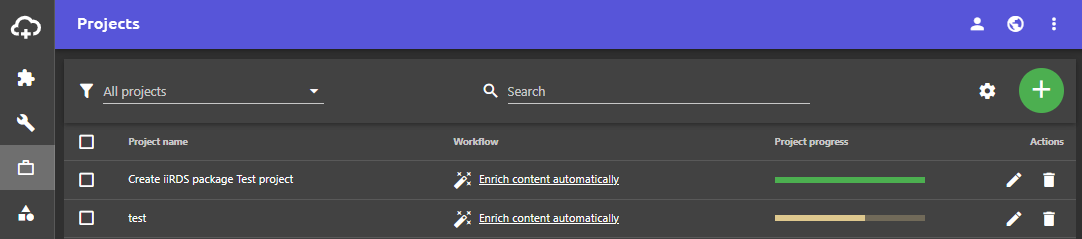
- The filter button is located at the top left. Filters can be set here.
Note: The filter function is not useful in some table views. In this case, the filter function is grayed out and cannot be clicked.
- The search bar is located next to the filter button. This can be used to search for objects. The search is performed in all table columns with text.
- Settings are located on the right-hand side. Among other things, columns can be added here and the file preview can be switched on and off.
- Depending on which view the table is in, there is an Add button to the right of the Settings. Add objects here, which are then displayed in the table view.
- The columns of the table view differ depending on where it is located. However, you will always find the checkboxes for selecting objects on the left side. On the right-hand side, there are usually buttons that can be used to start actions for the corresponding line (e.g. Delete object or Edit object).
- Below the table, you can set the rows per page (10, 25 or 50) and switch to the next page if the table is several pages long.
Filter
You can use the filter function to filter the objects displayed in the table according to their type.
- Click on the field next to the filter icon. A drop-down list opens. Next to the individual filter options, the number of objects for the corresponding filter can be seen in a blue circle.
Note: The drop-down lists differ slightly depending on which view the table is in. If checkboxes are displayed next to the filter options, several filters can be selected, otherwise only one.
- Select the types to be filtered.
The selected types are highlighted in yellow. - Click outside of the drop-down list to close the drop-down list.
You will only be shown the objects of the type(s) that you have selected in the filter.
Search
You can use the search bar to search for objects. All columns with text are searched so that you can also use this to filter the view, for example by searching for the “PDF” file type. Columns that are not displayed are also searched. So if you have hidden column Type of source file and search for “PDF”, all objects whose source file type is PDF will still be found.
Settings
File preview
In table views that list objects, a preview of the file can be viewed. It can be opened using the button .
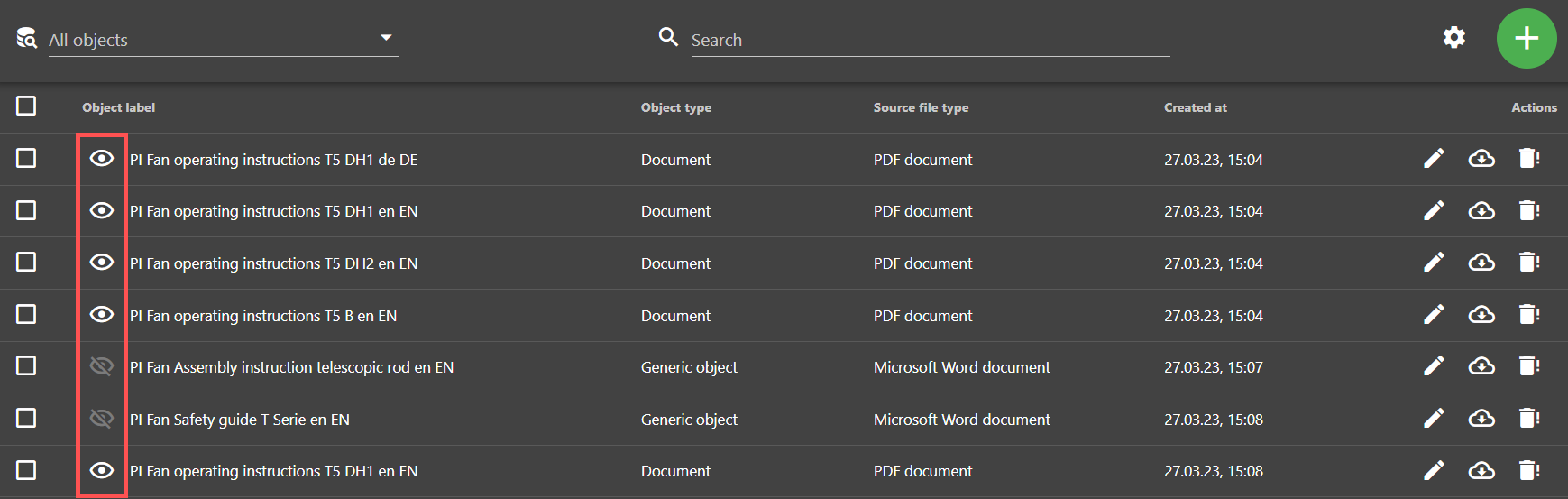
- Click on the button next to the object of which you would like to see a preview.
Note: Not all objects can be viewed in the file preview. HTML and PDF files, as well as image files, are fully supported; the text can be displayed for XML files. The quick preview function is crossed out for all unsupported file types:
- Click in an area next to the preview window to close the preview.
Other options:
- Click on the preview page to see an enlarged view.
- In the enlarged view, you have numerous further options. For example, you can use the arrow buttons or the slider to scroll through the pages of the preview if your file contains several pages.
Note: To ensure good performance, only the first page of a multi-page file is preloaded locally. If you click on the arrow button to see the next pages, the Document will be loaded from the server. For this reason, you may have to wait a short time for the file to be made available locally.
Download source file
In table views that list objects, the source files can be downloaded using the button.
- To download the file in the corresponding line, click on the button.
The download starts automatically and the button is filled in white , which means that the file has been downloaded from the server and is now available locally.
Edit columns
You can add or remove columns.
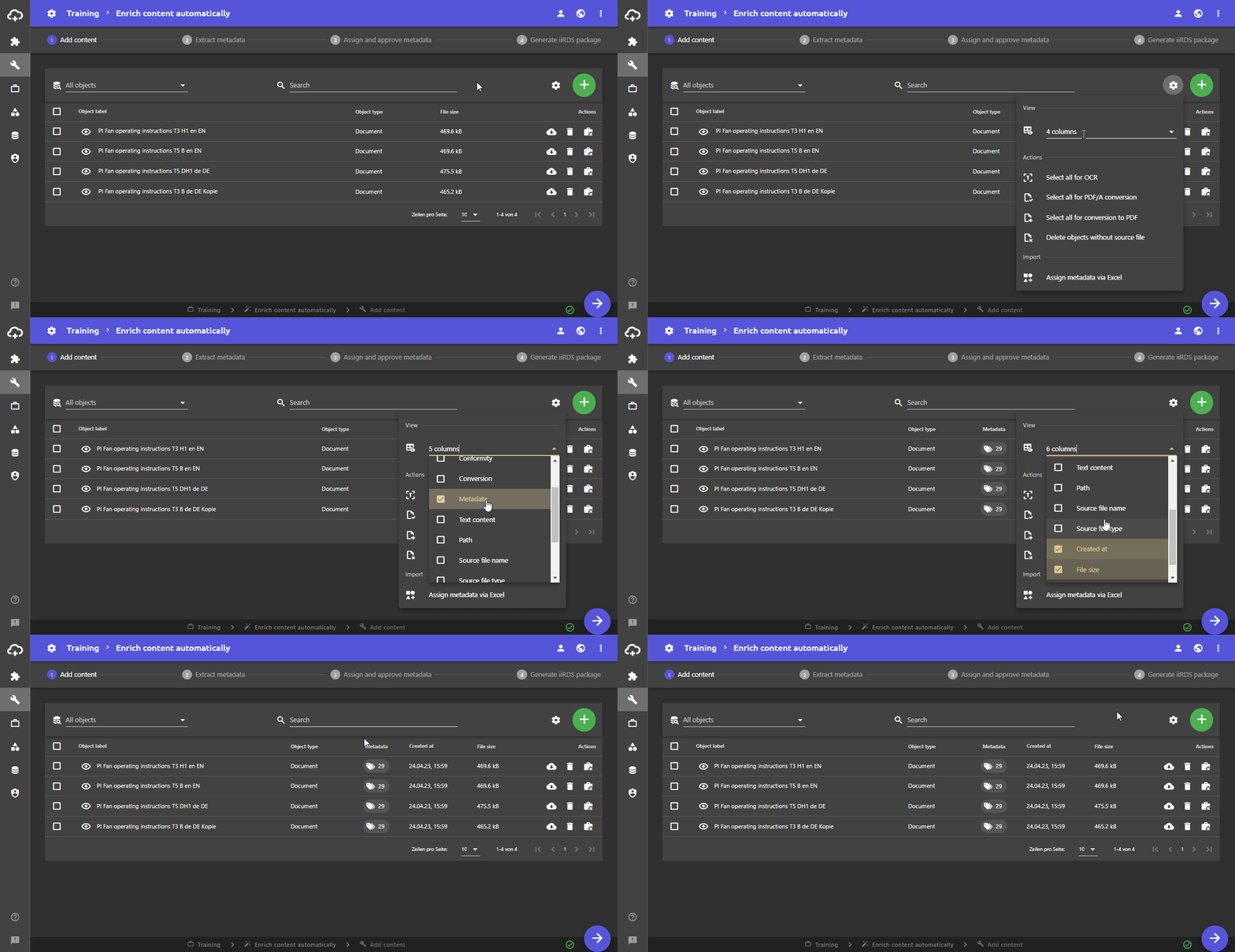
- Click on the settings button to open the settings.
- Click on the field next to the icon to expand a drop-down list with all available columns.
- To add columns, activate the checkbox next to the corresponding columns. To remove columns that are currently displayed, deactivate the checkbox next to the corresponding column.
The table view is automatically adjusted. - Click in an area next to the drop-down list to close it.
Sorting
By clicking on the column header, you can sort the table view according to the corresponding column. It is also possible to sort by several columns. Several icons are used for this:
- : Sort in ascending order (click once)
- : Sort in descending order (click twice)
The small number next to the arrow indicates the order in which they are sorted. For example, if you have activated two column headings for sorting, a 1 is displayed next to one and a 2 next to the other. In this case, sorting is first performed according to the column with the 1 and then according to the column with the 2.
Select multiple objects
- Click on the checkbox of a single row to select only this row
- Click on the checkbox in the top row (heading row) to select all rows on the page
Delete objects from the table
Delete individual objects
Within a table row, you can use the two buttons and to delete or remove an already added object from the project.
- Remove object from project. The object itself is not deleted and can be used elsewhere on the plusmeta platform.
- Delete object. In views within projects it indicates that the object is only used in this project.
- Delete object. The object is used in other projects and is removed from all projects by deleting it.
Delete multiple objects
If at least one object has been selected via the checkboxes in the table, you can use the buttons and to delete objects that have already been added or remove them from the project.
- Remove objects from the project
-
Delete objects
Note: If one of the selected objects is used in another project, this option is disabled.
